How does Halo promote posted needs?
Last updated: November 17, 2026
Halo promotes the two kinds of needs sponsors post differently. A PulseCheck asks "Who should I talk to?" It stays open for two weeks and goes to innovators already on Halo whose work fits, so most responses arrive in the first week.
A partnering request asks "Which solution should I move forward with?" Halo promotes it until the deadline with every channel it has: matched invitations and weekly digests to innovators on Halo, AI scouting agents that find people outside the network, referrals through channel partners, university research offices and colleagues, and LinkedIn.
Both also land where people already browse. Thousands of people visit Halo's marketplace every month, looking across sponsors and industries for problems their work can solve. A company's own innovation portal mostly reaches people who already know the company and go looking for it. Halo's marketplace reaches people who weren't looking for you, only for a problem like yours. They may even be looking for your competitor and instead find your posted need.
The goal either way is a short list of strong, relevant responses, not the largest possible pile. Every channel puts fit first, and Halo limits how often any one person hears from it, so its emails keep getting opened.
How is a PulseCheck promoted differently from a partnering request?
A PulseCheck is built for speed. Halo sends it to the innovators already on Halo whose work fits, through matched invitations and their weekly digests, and lists it in the marketplace. They can respond briefly in <5 minutes. PulseChecks get less scouting or referral outreach, by design. A partnering request brings all of Halo's reach to bear, and its longer window gives channel partners and colleagues time to make introductions and innovators time to prepare proposals.
PulseCheck | Partnering request | |
|---|---|---|
Question it answers | Who should I talk to? | Which solution should I move forward with? |
What innovators send | A raised hand and a sentence or two on why they fit | A detailed proposal |
Open for | Two weeks, then closes automatically | Until the deadline Halo recommends for your request |
Promotion | Matched invitations, weekly digests and the marketplace | All of those, plus AI scouting, referrals and LinkedIn |
Who it reaches | Innovators already on Halo | Halo's network plus people found through scouting and referrals |
When responses arrive | Most in the first week | Building toward the deadline, with over 40% in the final week |
A PulseCheck that draws few responses usually means the topic is highly specialized, not that promotion fell short. The usual next step is a partnering request, which keeps the ask specific and adds scouting and referrals to find niche fits. If the framing was the problem, Halo helps you reframe it as a new PulseCheck rather than rerun the same one, which would reach the same people.
For help choosing between them, see External Partnering Tools for Corporate Sponsors. The rest of this article covers full-service partnering requests, the kind Halo scopes and manages with you.
Partnering request promotion at a glance
Channel | Who it reaches | When |
|---|---|---|
Targeted invitations | Innovators on Halo whose work matches your request | Launch week, then follow-ups to strong matches and to people who show interest |
Weekly digests | Innovators and university research offices, ranked by relevance to each reader | Every week the request is open |
AI scouting agents | Researchers and companies not yet on Halo | From launch, sharpening as strong proposals arrive |
Network driven referrals | Channel partners, research offices and colleagues who pass your request on | Launch, then monthly through channel partners |
Scouted contacts and Halo's followers | While the request is open, plus a monthly roundup |
What happens before promotion starts?
Before launch, Halo's team reviews your draft and works with you to sharpen it. What you write does two jobs: it helps innovators decide whether to apply, and it tells Halo who to look for. Solutions of interest matter most. Halo's scouting agents search for each one separately, so a specific list of solutions reaches further than one broad description.
Preferred partner types tell innovators who you want to hear from, and a realistic TRL range and clear must-haves keep proposals on target. See Creating and Posting a Partnering Request and Partnering Request Questions for every field.
How should I set the budget and benefits?
Name a specific scope and a maximum budget. Innovators are usually willing to start small, with a pilot or a first phase, but they want to know there's enough funding behind the work before they invest time in a proposal.
Scope: what a first project would cover, its deliverables and roughly how long it runs.
Maximum budget: the most you'd spend on that scope. It isn't a guaranteed amount, and you can adjust it with the partner you select.
A stated maximum lets innovators judge whether the opportunity is worth their time and size their proposal to fit, and it keeps proposals you couldn't fund out of your queue. [EDITOR: add typical sponsored research budget range.]
Funding isn't the only benefit worth listing. Facilities, materials, data, expertise and market access are often what an innovator couldn't get on their own.
How does Halo decide who to invite?
Halo matches each request to the innovators on the platform whose work fits it best. The strongest matches receive a personal invitation to apply that links straight to your request. Matching also decides which requests appear in each innovator's weekly digest, so your request reaches the people most likely to act on it rather than everyone.
After launch, Halo follows up with strong matches who haven't applied yet and with people who have shown interest, such as returning to your request or starting a proposal. Halo also caps how often any one person hears from it.
Who sees my request?
Within Halo's network, three groups see your request:
Matched innovators, through direct invitations and a weekly digest that shows each reader the live requests most relevant to them.
University research offices, which receive a weekly digest of live requests and often pass it to faculty. Some publish it on their own funding pages.
Innovators browsing Halo's marketplace, which draws thousands of visitors each month.
If you hide your company name, the request appears as posted by a Private Company, and Halo's emails, channel partner messages and LinkedIn posts keep it that way. Scouting and referrals then carry your request beyond the network, as the next two sections explain.
How does Halo find people outside its network?
Not every strong partner is on Halo yet. For partnering requests, Halo runs AI scouting agents that search for people working on your problem, one solution of interest at a time. Scouted researchers and companies receive a personal email, and sometimes a LinkedIn message, inviting them to review your request and apply.
Scouting keeps working after launch. As proposals arrive, the agents study the strongest ones and look for more people like them, so the search sharpens while your request is open.
This reach is what sponsors notice most. Kraft Heinz's R&D technology scouting lead put Halo's top impact as finding innovators "none of our other tools could find" (case study).
How do referrals extend a request's reach?
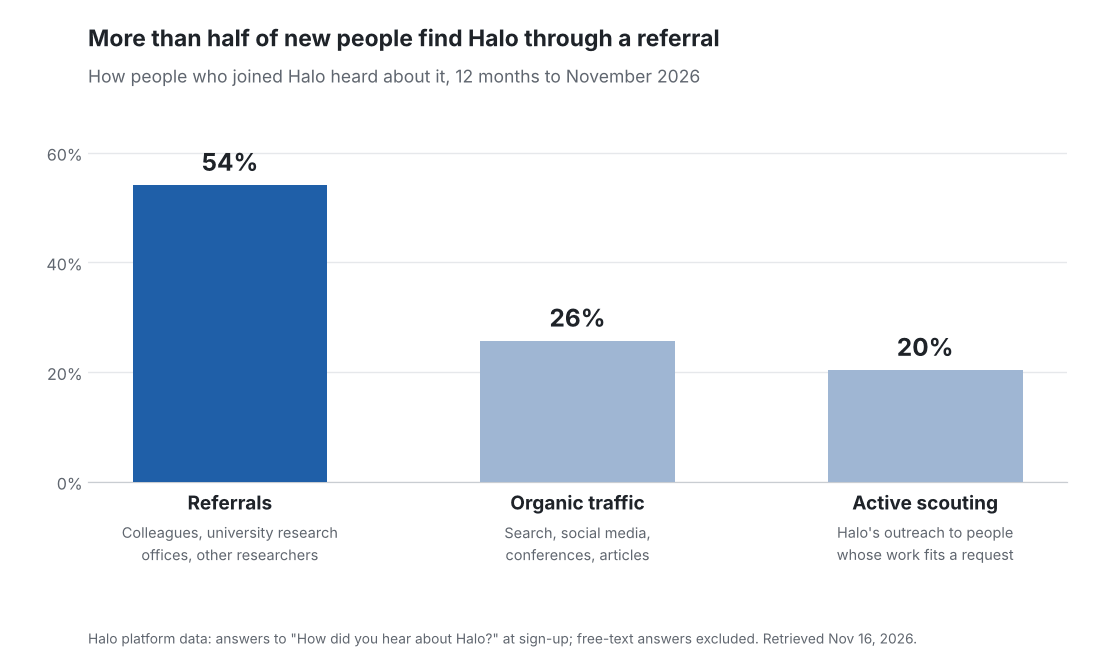
Referrals are the most common way new people find Halo. When people join, Halo asks how they heard about it. Of those who joined in the 12 months to November 2026, 54% heard about Halo through a referral, mostly from a colleague or a university research office. Another 26% found Halo on their own, through search, social media, conferences or articles, and 20% came through Halo's active scouting.
That's an edge no search can copy. A referral carries judgment: someone who knows the problem and knows the person decides they're a fit, often before that person's work is published, indexed or described in the words a sponsor would search. Those connections live inside professional relationships, so they don't show up in a database or an AI model's training data. AI tools and databases can only return what has already been written down and categorized. A network keeps reaching the people who haven't been.
Halo builds referrals into promotion through three groups:
Channel partners. A channel partner is an organization that serves a community of innovators, such as an accelerator, industry association, investor or research consortium. Halo sends channel partners a monthly email of live requests grouped by industry, written to forward as is. When a request needs wider reach, Halo asks new channel partners in that field to refer specific people.
University research offices. Research administrators get a weekly digest of live requests and pass relevant ones to faculty. Some post them on their own funding pages.
Colleagues. Researchers who aren't the right fit often forward a request to someone who is. It's the single most common way new people arrive.
Referrals reach people other channels miss: early-stage founders, specialists outside academia, and researchers who haven't published on the topic yet.
Why does Halo find partners that AI search misses?
Because the strongest partner often works outside the field a sponsor would think to search, under a name that doesn't match the problem.
86% of finalists selected by Halo sponsors in the past 12 months would not have been identified by Claude or ChatGPT. 71% of startup finalists wouldn't have been surfaced by AI, and 82% don't appear in Crunchbase or PitchBook.
AI tools and databases find people by how they describe themselves. A sponsor's brief is written in the sponsor's language. When the two don't match, search comes up empty, and the mismatch is widest across industries. Recent finalists include an agricultural research institute answering a skin-science request, a spectroscopy physicist answering a crop-monitoring request, and an antifungal chemist answering a lawn-care request.
Sponsors see the same pattern. In a Halo customer survey, 91% said they discovered partners on Halo they weren't aware of before. Translating across fields is also the focus of a $1.2M project Halo leads for the National Science Foundation's TIP Directorate, using AI to map universities' academic expertise to industry applications.
Halo's promotion is built for that gap:
Scouting by solution of interest. Each solution is searched on its own, by the capability it needs rather than the industry it usually sits in.
Inviting people for their work, not their label. Halo invites innovators whose work fits the problem, even when their field goes by a different name.
Learning from strong proposals. When an unexpected field produces a strong proposal, scouting agents look for more people like it.
Letting experts recognize the problem. An open request lets a researcher in an adjacent field see that their work applies, a connection no search from the sponsor's side would predict.
Referrals. Colleagues and channel partners pass requests to people with no public footprint in the area yet.
To make the most of this, use your out-of-scope list for approaches you've ruled out, not for industries. Many finalists come from outside the sponsor's own.
How this is measured: for each finalist, Halo assesses whether Claude or ChatGPT, given the sponsor's brief, would have recommended them, and checks startups against Crunchbase and PitchBook.
How long does promotion run?
Promotion starts on launch day and runs until your submission deadline. There's no fixed length: Halo recommends one for each request based on what you need and how large the pool of likely partners is. Launch week brings the heaviest outreach, and digests, follow-ups and channel partner emails continue after that.
Halo also watches early signals, such as proposals started, questions asked in Q&A and visits to the submission page. When a request draws less interest than similar requests, Halo adds outreach.
When do responses arrive?
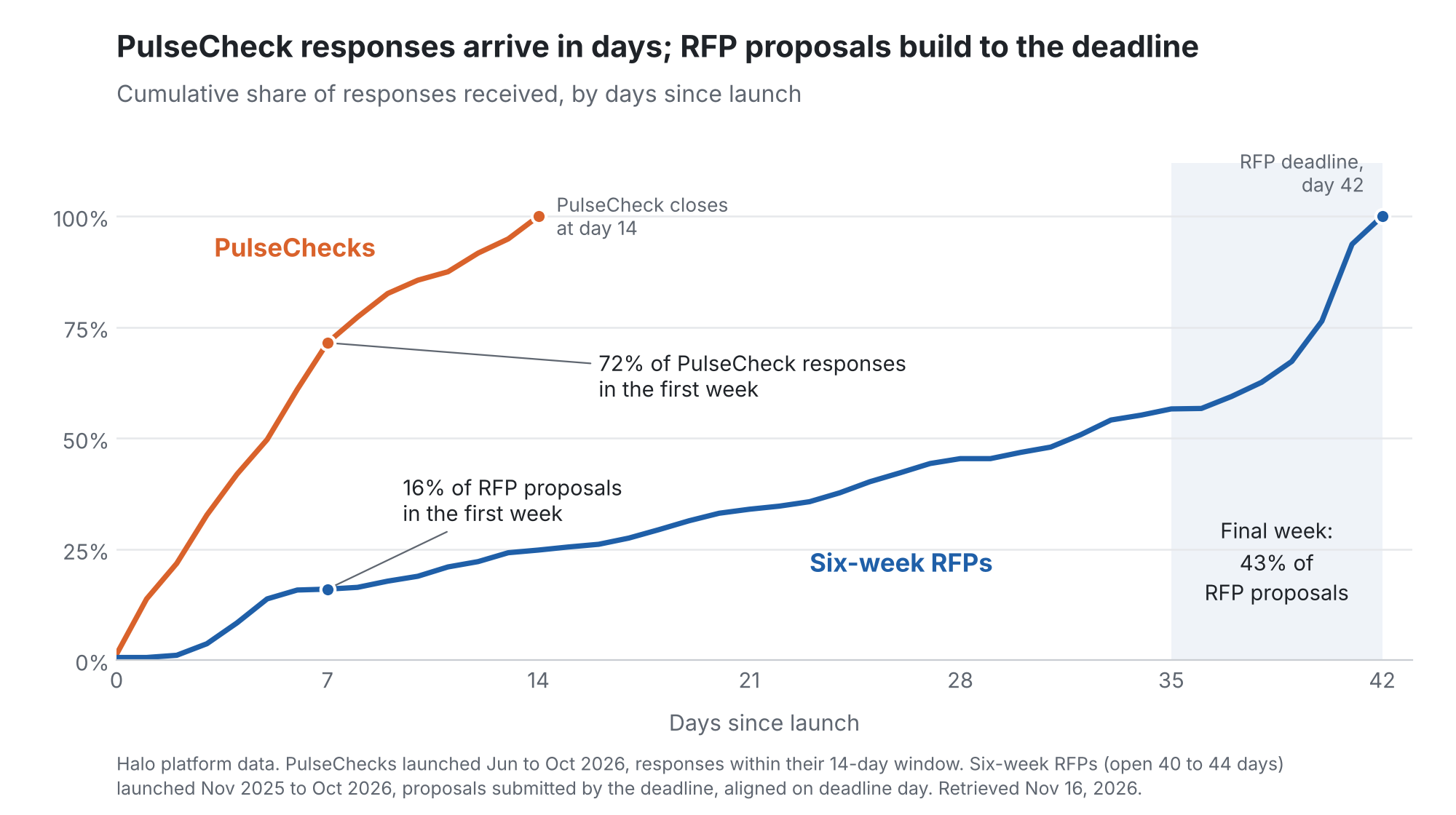
PulseChecks and partnering requests collect responses on very different clocks. PulseChecks stay open for two weeks and go mainly to innovators already on Halo, so responses come fast: nearly three-quarters arrive in the first week, and the rest by day 14, when the PulseCheck closes. See Posting PulseChecks.
Partnering requests get every channel, including scouting and referrals, and a proposal takes real work to prepare, so responses build toward the deadline. On a standard six-week request, about one in six proposals arrives in the first week, more than half arrive in the final two weeks, and over 40% in the final week alone. A quiet first few weeks on a request is normal, not a sign it isn't reaching people.
Does hiding your company name affect responses?
Yes, for both PulseChecks and partnering requests.
Anonymous PulseChecks typically receive ~30–40% fewer responses. Anonymous partnering requests see the same drop in proposals, and innovators who submit won't be added to your network.
Innovators have less context about the opportunity, so fewer decide it's worth their time.
If you can name your company, do. If you can't, give innovators enough context to judge the opportunity: your industry, the scale of the problem and what you're offering.
How does Halo keep outreach relevant?
Halo ranks every email by relevance to the person reading it, limits how often anyone hears from Halo, and uses broad lists only as a last resort. The reason is practical. Innovators who get irrelevant email stop opening it, and that would cost every sponsor on their next request. Fit comes first, then reach.
How do I balance reach and relevance?
Reach and relevance pull in opposite directions. Loosen a requirement and more people can apply; tighten it and the proposals you get sit closer to what you need. Most choices in a request trade one for the other. See best practices for writing a partnering request for how to word each field.
Choice | For more reach | For more relevance |
|---|---|---|
Must-have requirements | Keep to a few, written as outcomes, so adjacent approaches qualify | Add the specs, standards or scale a solution has to meet |
Solutions of interest | Include adjacent and unconventional approaches | List only the approaches you'd fund |
TRL range | Accept earlier-stage work you could develop with a partner | Limit to the maturity you can use now |
Partner types | Select every type you'd consider | Select only the types that can deliver, such as suppliers for a scale-up |
Geography | Accept international equivalents of standards and approvals | Limit to regions where you can contract and work |
Halo will advise you on the balance. Where each setting belongs depends on what the request is for: a search for new approaches should lean toward reach, while a request for something you plan to deploy soon should lean toward relevance. Before launch, Halo's team looks at how many likely partners exist for the request as written and recommends where to loosen or tighten. After launch, if early signals show the request drawing too little interest, or the wrong kind, Halo can suggest changes. The target is the 10 to 25 proposal range Halo's data points to, filled with partners you'd actually pursue.
Some steps help on both counts:
Name your company if you can. Anonymous requests typically receive 30%-40% fewer proposals, and innovators who submit won't be added to your network.
State a scope and a maximum budget. Innovators will start small, but they want to know funding exists before they invest in a proposal.
List each solution of interest separately. Halo scouts each one on its own, so a specific list widens the search without loosening your requirements.
Answer Q&A quickly. Halo forwards each question to you, and fast answers keep applicants moving.
Share the link with your own network and partners. Referrals are the most common way new people find Halo.
Frequently asked questions
How many proposals can I expect? Halo's analysis of several years of request data puts the sweet spot at 10 to 25 proposals. Successful partnerships also come from just a handful of strong-fit proposals. The number depends on how specialized the topic is, the requirements and the timeline, so Halo doesn't guarantee a count. Your Halo contact can review early signals with you and suggest changes.
Is it normal to receive few proposals in the first weeks? Yes. On a standard six-week request, about one in six proposals arrives in the first week and over 40% arrive in the final week before the deadline. Innovators need time to prepare a proposal, and many submit close to the deadline.
Can a confidential request still reach innovators? Yes. With your company name hidden, the request appears as posted by a Private Company and Halo promotes it through the same channels. Anonymous requests typically receive 30%-40% fewer proposals, and innovators who submit proposals won't be added to your network.
Is it free for innovators to apply?
Yes. Halo is free for innovators; sponsors pay for access and to post requests. See How does Halo make money?
How is a partnering request different from a listing on an open innovation site? A listing waits to be found. Halo invites matched innovators directly, ranks your request into the digests of people likely to fit, and adds AI scouting and referrals to reach people who aren't on Halo yet.
Can ChatGPT or Claude find the same partners Halo does?
Usually not. 86% of finalists selected by Halo sponsors in the past 12 months would not have been identified by Claude or ChatGPT given the same brief. Many work in an adjacent field, have little public footprint, or run startups that don't appear in Crunchbase or PitchBook.
Last updated November 2026.
Related articles: External Partnering Tools for Corporate Sponsors · Creating and Posting a Partnering Request · Posting PulseChecks